FINANCIAL SERVICES & REAL ESTATE SECTOR PRACTICE
Commercial Real Estate & PropTech Digital Transformation
Modernizing property asset management, real estate investment trusts (REITs), lease accounting (ASC 842), IoT smart building infrastructure, and Dynamics 365 property ERP solutions.
- Commercial Asset Management
- REIT Financial Systems
- ASC 842 Lease Automation
- PropTech IoT Telemetry
- Dynamics 365 Real Estate ERP

STRATEGIC PERSPECTIVE
The Real Estate Modernization Mandate: Navigating Structural Industry Transformation
Strategic Imperative: Hybrid work models, elevated interest rates, and evolving tenant expectations demand that commercial real estate owners and REITs adopt automated property ERP architectures and IoT PropTech.
The commercial real estate (CRE) sector is navigating one of the most profound operational and financial structural shifts in modern history. Shifting tenant occupancy demands, rising debt financing costs, evolving sustainability mandates (ESG), and complex lease accounting standards have permanently disrupted traditional property management models. Operating with siloed property management software, manual rent roll spreadsheets, and disconnected facilities systems destroys net operating income (NOI) and leaves asset managers blind to asset-level portfolio performance.
Routeget’s Commercial Real Estate & PropTech Industry Practice provides end-to-end management consulting, financial systems modernization, and digital transformation services tailored for real estate investment trusts (REITs), private equity real estate funds, and institutional property managers. We combine deep real estate financial acumen with enterprise cloud architecture to optimize asset performance and streamline investor reporting.
Our certified real estate technology specialists deploy unified property ERP platforms on Microsoft Dynamics 365, automate complex ASC 842 / IFRS 16 lease accounting schedules, integrate smart building IoT telemetry, and optimize tenant billing workflows. By connecting property operations directly to corporate general ledgers, Routeget empowers real estate leaders to maximize NOI, reduce vacancy friction, and deliver transparent reporting to institutional capital partners.
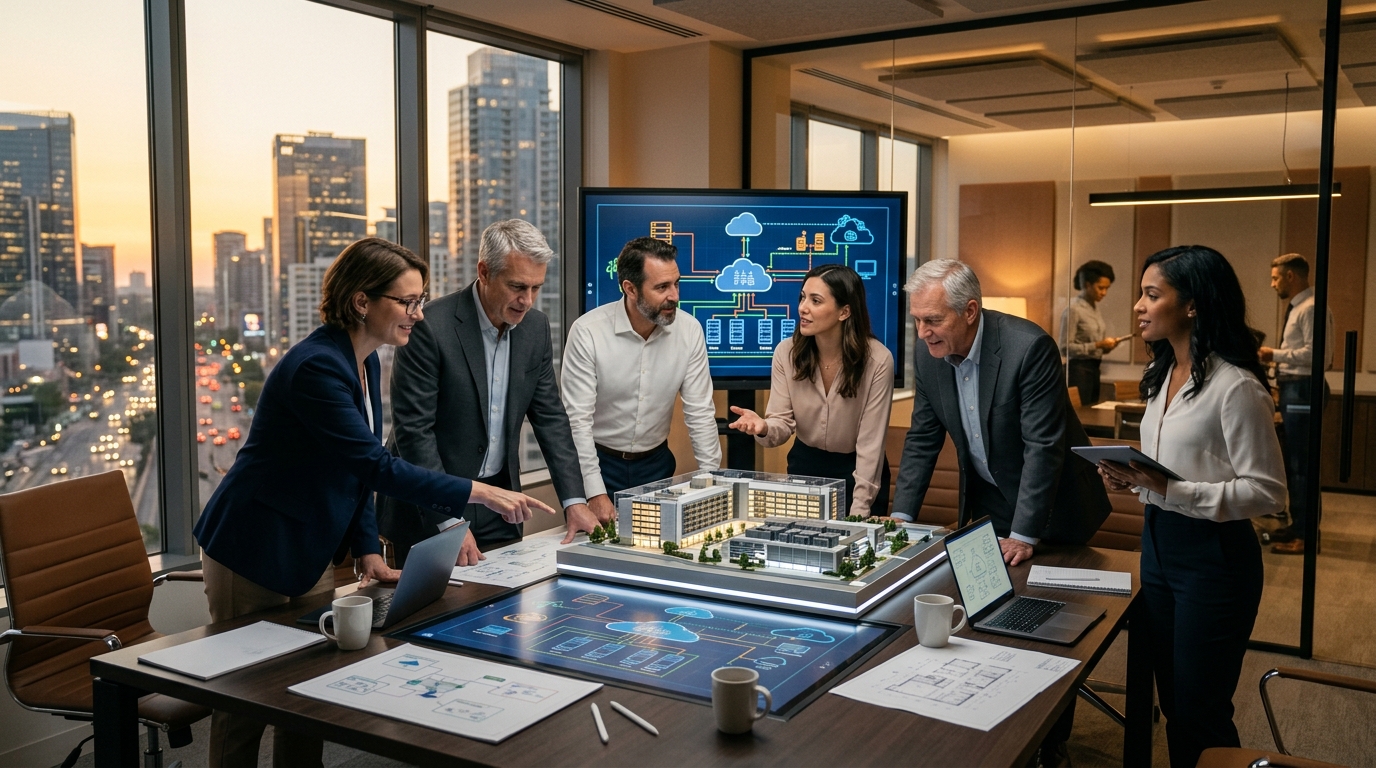
CORE ARCHITECTURAL PILLARS
Real Estate Practice Capability Matrix
Four foundational industry pillars modernizing commercial real estate operations and maximizing portfolio NOI.
Property ERP
Dynamics 365 Enterprise Real Estate ERP Solutions
Unifying property management, lease administration, general ledger accounting, and procurement within Microsoft Dynamics 365.
Pillar 01 Scope & Governance
Lease Compliance
ASC 842 & IFRS 16 Lease Accounting Automation
Automating balance-sheet lease capitalization, right-of-use asset valuation, and lease modification accounting.
Pillar 02 Scope & Governance
Asset Optimization
REIT Financial Management & Portfolio Analytics
Delivering institutional-grade asset management dashboards tracking Net Operating Income (NOI), cap rates, and funds from operations (FFO).
Pillar 03 Scope & Governance
PropTech & IoT
Smart Building PropTech & ESG Energy Telemetry
Integrating building automation systems, IoT sensors, and environmental sustainability telemetry into ERP ledgers.
Pillar 04 Scope & Governance
TECHNICAL SPECIFICATIONS & SLA COMMITMENTS
Detailed Architecture Specifications & Delivery Governance
Comprehensive functional requirements, implementation guardrails, and enterprise SLA obligations across all operating pillars.
Dynamics 365 Enterprise Real Estate ERP Solutions — Detailed Specifications
- Integrated Lease Accounting & Billing: Automating rent rolls, CPI escalations, percentage rent calculations, and common area maintenance (CAM) reconciliations.
- Multi-Entity Property Consolidation: Engineering automated consolidation roll-ups spanning individual property SPEs, joint ventures, and REIT parent entities.
- Tenant Self-Service Portals: Deploying digital portals for automated online rent payments, maintenance requests, and digital lease renewals.
- Capital Project & Construction Accounting: Managing property renovation budgets, contractor lien waivers, and CapEx drawdowns in real time.
ASC 842 & IFRS 16 Lease Accounting Automation — Detailed Specifications
- Lease Data Extraction & Abstraction: Utilizing AI document processing to extract critical lease covenants, renewal options, and payment terms.
- Right-of-Use (ROU) Asset Schedules: Automating amortization tables, interest expense calculations, and lease liability adjustments.
- Lease Modification Accounting: Modeling the financial statement impacts of lease amendments, early terminations, and rent concessions.
- Audit-Ready Footnote Generation: Automatically compiling mandatory SEC and GAAP lease disclosure footnote schedules.
REIT Financial Management & Portfolio Analytics — Detailed Specifications
- Real-Time NOI & FFO Telemetry: Calculating Funds From Operations (FFO) and Adjusted FFO (AFFO) across property classes and regions.
- Occupancy & Lease Expiration Modeling: Forecasting lease rollover exposure and modeling renewal probability scenarios across portfolio assets.
- Debt Covenant & Liquidity Tracking: Providing daily visibility into loan-to-value (LTV) ratios, debt yields, and debt service coverage.
- Investor Capital Reporting: Generating automated capital call notices, distribution waterfall calculations, and quarterly investor briefing books.
Smart Building PropTech & ESG Energy Telemetry — Detailed Specifications
- IoT Energy & Carbon Telemetry: Connecting smart meters to track electricity, water, and gas consumption for automated ESG reporting.
- Predictive Facilities Maintenance: Utilizing IoT vibration and thermal sensors to schedule HVAC and elevator maintenance before costly breakdowns.
- Space Utilization Analytics: Monitoring tenant badge and occupancy sensor data to optimize floorplans and flexible leasing models.
- Smart Access & Security Integration: Integrating digital credentialing with tenant directory systems to enhance building security.
DELIVERY METHODOLOGY
XDRI™ Proprietary Enterprise Delivery Framework
A structured four-phase delivery methodology ensuring predictable outcomes, zero operational disruption, and accelerated time-to-value.
Phase 01
eXplore & Audit
Forensic evaluation of legacy systems, integration dependencies, security posture, and workflow bottlenecks.
Deliverable: Comprehensive Technical Debt Audit & Modernization Charter
Phase 02
Design & Architect
Formulation of target-state cloud architecture, unified data schemas, and governance controls.
Deliverable: Target Architecture Blueprint & Migration Roadmap
Phase 03
Realize & Implement
Agile, sprint-driven implementation featuring automated CI/CD pipelines, zero-downtime cutovers, and UAT.
Deliverable: Validated Production Deployment & Cutover Sign-Off
Phase 04
Impact & Optimize
Hypercare transition, automated telemetry monitoring, proactive tuning, and SLA-governed support.
Deliverable: Continuous SLA Governance & Value Realization Scorecard
QUANTIFIABLE IMPACT
Measurable Business Outcomes & Performance Metrics
Quantifiable operational enhancements achieved through disciplined architecture, automated governance, and cloud optimization.
Reduction in manual processing workflows across business units
Enterprise cloud reliability backed by multi-region redundancy
Accelerated turnaround through unified real-time data models
End-to-end immutability across regulatory and financial records
EXECUTIVE FAQ
Real Estate Industry Practice FAQs
Critical architectural, operational, and licensing considerations for executive leadership and steering committees.
What is Common Area Maintenance (CAM) reconciliation, and why is it a major source of revenue leakage?
How does Microsoft Dynamics 365 support commercial real estate enterprises?
How does ASC 842 impact commercial real estate landlords and tenants?
How can PropTech and IoT sensors increase Net Operating Income (NOI)?
ENTERPRISE TRANSFORMATION
Accelerate Your Enterprise Transformation with Routeget
Consult with Routeget’s certified enterprise architects to modernize legacy systems, unify multi-entity operations, and achieve scalable cloud agility.
