

If you’re an Construction Business owner, the most costly claims and disputes arise from construction defects and warranty claims. But if you’re a GC, the most costly disputes are from subcontractor defaults, termination or failure.
These are two very different driving factors for mitigating these risks but how to mitigate the risk itself is universal. 91% of owners and contractors surveyed by Dodge Data & Analytics for the 2017 SmartMarket Brief, Risk in the Construction Industry, feel that increased collaboration reduces risk. Seems easy enough, right? So why are most owners and GCs still running into issues?
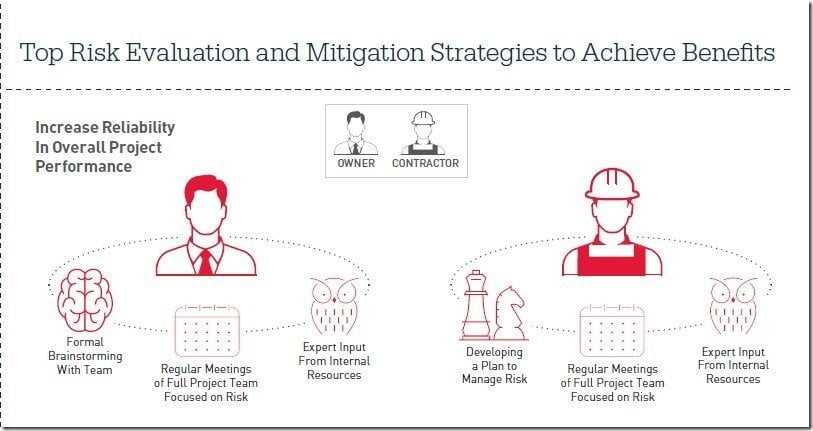
It simply boils down to lack of communication and information flow across the project team. The top trigger that encourages increased use of construction risk management practices are reported to be the tendency for clients to shift project risk over to the contractors (59%). And by assigning risks in contracts to specific parties, this actually discourages collaborative behavior. Shared risk and reward contracts are just one of many ways to eliminate that “he-said, she-said.”
Whether you’re an owner or a general contractor, respondents to Dodge’s survey said that to increase reliability in overall project performance, regular meetings of full project teams, which are solely focused on risk factors, are crucial.

In Routeget’s experience, we’ve seen entire teams created specifically for the purpose of monitoring and mitigating risk. At the beginning of the project, this team collaborated with stakeholders to develop a series of workflows to manage risk. To take it one step further, once the processes were developed, they were codified into a process automation platform deployed to execute and enforce these processes. Today processes for change orders, daily reports, correspondence, RFIs and submittals have all been standardized so that the process is streamlined and questions are minimized to ensure responses are generated quickly.
The Project Controls Team has access to hundreds of reports that provide visibility into projected commitments, potential change orders and supporting documentation, current costs, and other risks. Every month the team has to report on change order totals and categories of contingency use to many different groups. This is collaboration at its finest.
ConstructPro solution for Construction Management helps you to collaborate more effectively with all stakeholders and perform Risk Management at your Project control office.
Enterprise Architecture & ERP Implementation Governance
Transitioning complex organizational workflows into scalable ERP modernization architectures requires systematic alignment between core operational processes and underlying digital infrastructure across all operating subsidiaries. When executing enterprise deployments within intricate multi-entity business environments, organizations must rigorously prioritize data normalization, chart-of-accounts standardization, and unified telemetry architectures. Establishing resilient, pre-configured integration boundaries across legacy application estates directly eliminates technical debt while ensuring end-to-end data integrity across high-frequency transactional lifecycles. Cross-functional governance committees—uniting financial controllers, supply chain leaders, and enterprise technical architects—remain indispensable for maintaining strict configuration discipline and curbing procedural fragmentation across regional operating units.
Beyond core transactional execution, enduring platform longevity depends on deliberate organizational enablement and continuous operational validation across all stakeholder tiers. Implementing isolated sandbox environments, automated regression testing frameworks, and formalized release cadence protocols enables business units to absorb continuous platform enhancements without introducing unexpected downtime or operational friction. Enterprises that deliberately pair proactive telemetry monitoring with targeted role-based training programs consistently achieve accelerated user adoption, compress post-go-live stabilization horizons, and maximize the long-term return on strategic technology investments. This disciplined operating model provides the institutional agility needed to scale operations predictably.



No comment yet, add your voice below!