

The XDRI Framework™ is a comprehensive project delivery proprietary methodology developed by Routeget Technologies that focuses on accelerated development and rapid implementation. By leveraging iterative cycles and a collaborative approach, XDRI™ is ideal for large enterprise projects, ensuring timely delivery, reduced risks, and enhanced business alignment.
XDRI Approach: The XDRI Framework™ (Accelerated Development & Rapid Implementation) is a structured approach designed to streamline the development and deployment of large enterprise projects. It focuses on breaking down complex projects into manageable phases, allowing for continuous refinement, integration, and validation through iterative cycles. This approach ensures that the final product meets business requirements, integrates seamlessly with existing systems, and is delivered in a timely and cost-effective manner.
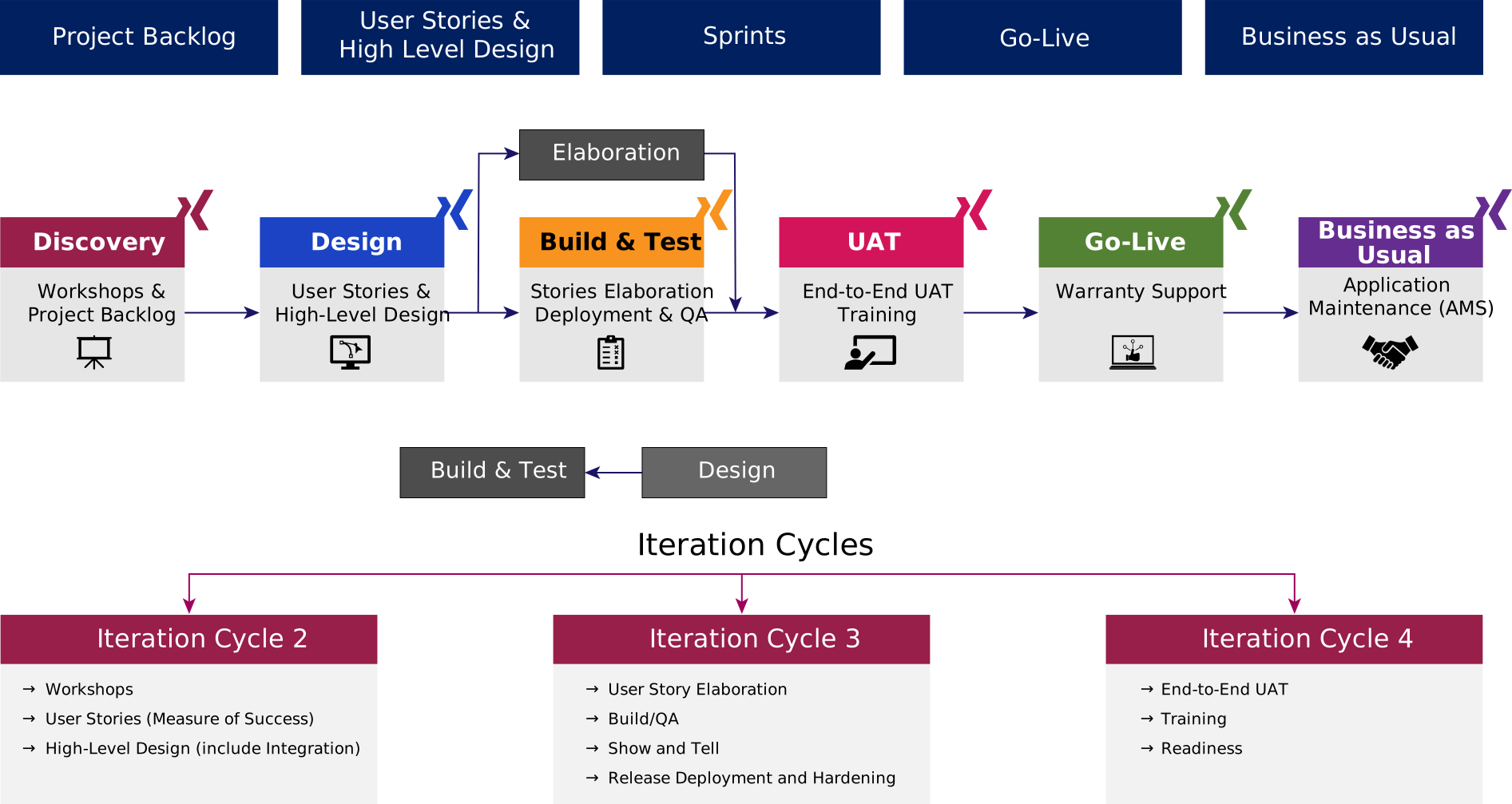
Project Backlog
Discovery: In this phase, workshops are conducted to gather requirements, and a comprehensive project backlog is created. This backlog serves as the foundation for the entire project, listing all tasks and features that need to be addressed.

User Stories & High-Level Design
Design: Here, user stories are created, and a high-level design of the system is developed. These stories represent specific requirements or features that the system must have, guiding the development process.
Sprints
- Elaboration: This is a detailed phase where the user stories are further elaborated, and the development team prepares for the build process.
- Build & Test: In this phase, the system is built according to the user stories, and rigorous testing is conducted to ensure that the system functions as intended.
Go-Live
- User Acceptance Testing: The system undergoes end-to-end UAT, where it is tested in an environment that mimics real-world conditions. Users are trained, and any issues are identified and resolved.
- Go-Live: The system is deployed, and warranty support is provided to address any post-implementation issues.
Business as Usual
After the system goes live, it transitions into a “Business as Usual” phase, where it becomes part of the organization’s regular operations.
Comparison with Common Project Delivery Frameworks
- Agility – Unlike the Waterfall model, which follows a linear approach, the XDRI Framework is highly flexible, allowing for changes to be made at any stage of the project.
- Continuous Improvement – The use of iteration cycles in the XDRI Framework ensures that the system is continuously refined, something that is often lacking in traditional frameworks.
- Faster Delivery – By focusing on rapid implementation and accelerated development, the XDRI Framework can deliver projects more quickly than frameworks that require extensive documentation and approval processes.
- Enhanced Collaboration – The framework encourages collaboration between different stakeholders through workshops, user stories, and UAT, leading to better alignment with business needs.
Why the XDRI Framework is Better for Large Enterprise Projects
- Scalability – The XDRI Framework is designed to handle the complexities of large, multi-country operations, making it ideal for enterprises with global reach.
- Risk Mitigation – By incorporating multiple iteration cycles, the framework allows for continuous testing and refinement, reducing the risk of costly errors.
- Business Alignment – The framework’s focus on user stories and UAT ensures that the final product is closely aligned with business objectives, leading to higher satisfaction and better ROI.
The XDRI Framework is a robust and flexible approach to project delivery that is particularly well-suited for large enterprise projects. Its focus on accelerated development, rapid implementation, and continuous improvement makes it a superior choice compared to traditional project management frameworks. By adopting the XDRI Framework, organizations can ensure that their projects are delivered on time, within budget, and with a high degree of quality and user satisfaction.
Executive Takeaways & Long-Term Value Realization
Orchestrating sustainable corporate transformation requires decisive executive leadership capable of harmonizing high-level strategic board mandates with practical operational execution across all core operating divisions. Major enterprise initiatives frequently encounter friction not from technological constraints, but from fragmented departmental communications, misaligned performance incentives, and unaddressed cultural resistance to procedural evolution across business units. By articulating transparent programmatic milestones, unified performance dashboards, and shared ownership structures across departmental boundaries, leadership teams build the organizational clarity necessary to navigate complex modernization initiatives decisively, predictably, and with minimal operational friction.
Achieving enduring commercial leadership in dynamic market environments necessitates treating organizational agility and human capital development as essential core corporate capabilities. Establishing open operational feedback loops, celebrating iterative program successes, and delivering tailored professional development tracks empowers enterprise teams to adapt to market disruptions proactively and confidently across every functional tier. Enterprises that champion methodical execution, continuous innovation, and cross-functional synergy consistently outperform industry peers in operational productivity, employee retention, and overall customer satisfaction across competitive global markets worldwide. This unified cultural discipline ensures organizational stability throughout broad technological modernization journeys. This structured alignment provides the operational stability required for enduring digital maturity.



No comment yet, add your voice below!