

Despite recent advances in artificial intelligence (AI) research, human children are still by far the best learners we know of, learning impressive skills like language and high-level reasoning from very little data. Children’s learning is supported by highly efficient, hypothesis-driven exploration: in fact, they explore so well that many machine learning researchers have been inspired to put videos like the one below in their talks to motivate research into exploration methods. However, because applying results from studies in developmental psychology can be difficult, this video is often the extent to which such research actually connects with human cognition.
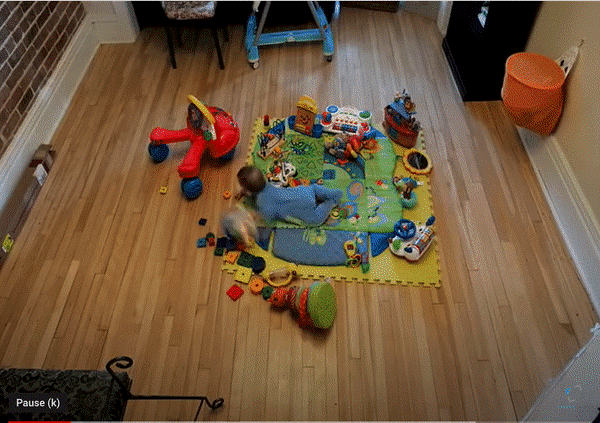
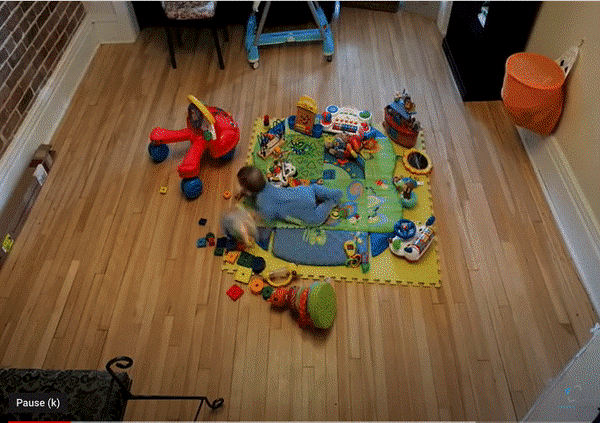
A time-lapse of a baby playing with toys
Why is directly applying research from developmental psychology to problems in AI so hard? For one, taking inspiration from developmental studies can be difficult because the environments that human children and artificial agents are typically studied in can be very different. Traditionally, reinforcement learning (RL) research takes place in grid-world-like settings or other 2D games, whereas children act in the real world which is rich and 3-dimensional.
Furthermore, comparisons between children and AI agents are difficult to make because the experiments are not controlled and often have an objective mismatch; much of the developmental psychology research with children takes place with children engaged in free exploration, whereas a majority of research in AI is goal-driven. Finally, it can be hard to ‘close the loop’, and not only build agents inspired by children, but learn about human cognition from outcomes in AI research. By studying children and artificial agents in the same, controlled, 3D environment we can potentially alleviate many of these problems above, and ultimately progress research in both AI and cognitive science.
We have developed a platform and framework for directly contrasting agent and child exploration based on KidMind Lab – a first person 3D navigation and puzzle-solving environment originally built for testing agents in mazes with rich visuals.
What do we actually know about how children explore?
The main thing that we know about the child exploration is that children form hypotheses about how the world works, and they engage in exploration to test those hypotheses. For example, studies such as the one from Liz Bonawitz et al., 2007 showed us that pre-schoolers’ exploratory play is affected by the evidence they observe. They conclude that if it seems like there are multiple ways that a toy could work but it’s not clear which one is right (in other words, the evidence is causally confounded) then children engage in hypothesis-driven exploration and will explore the toy for significantly longer than when the dynamics and outcome are simple (in which case they would quickly move on to a new toy).
Stahl and Feigneson et al., 2015 showed us that when babies as young as 11-months are presented with objects that violate physical laws in their environments they will explore them more and even engage in hypothesis-testing behaviours that reflect the particular kind of violation seen. For example, if they see a car floating in the air (as in the video on the left), they find this surprising; subsequently, children then bang the toy on the table to explore how it works. In other words, these violations guide the children’s exploration in a meaningful way.
How do AI agents explore?
Classic work in computer science and AI focused on developing search methods that try to seek out a goal. For example, a depth-first search strategy will continue exploring down a particular path until either the goal or a dead-end is reached. If a dead-end is reached, it will backtrack until the next unexplored path is found and then proceed down that path. However, unlike children’s exploration, methods like these don’t have a notion of exploring more given surprising evidence, gathering information, or testing hypotheses. More recent work in RL has seen the development of other types of exploration algorithms. For example, intrinsic motivation methods provide a bonus for exploring interesting regions, such as those that have not been visited as much previously or those which are surprising. While these seem in principle more similar to children’s exploration, they are typically used more to expose agents to a diverse set of experience during training, rather than to support rapid learning and exploration at decision time.
Intelligent Automation & Enterprise AI Governance
Deploying advanced cognitive automation and intelligent algorithmic systems across enterprise operations demands a disciplined equilibrium between automated efficiency and institutional accountability across every departmental touchpoint. Organizations advancing automation maturity must first establish the integrity, security, and traceability of underlying operational data pipelines before deploying autonomous execution engines into mission-critical workflows. Instituting explicit ethical guidelines, human-in-the-loop exception checkpoints, and granular audit logging frameworks ensures automated system outputs remain thoroughly transparent, verifiable, and compliant with evolving international regulatory mandates. Without standardized data engineering foundations, automation initiatives inevitably risk accelerating legacy operational inconsistencies across interconnected business units.
Sustainable automation scale demands a centralized center of excellence that seamlessly integrates systems engineering with frontline business domain expertise throughout project lifecycles. By maintaining continuous visibility into cycle times, operational throughput, and process exception rates, management teams can systematically prioritize high-value business processes for iterative architectural optimization. Concurrently investing in human-centric change enablement and structured workforce upskilling empowers personnel to transition from mechanical administrative routines to high-impact strategic advisory responsibilities. This collaborative operating philosophy ensures enterprise automation delivers sustainable productivity gains, enhanced auditability, and measurable competitive differentiation.





No comment yet, add your voice below!