

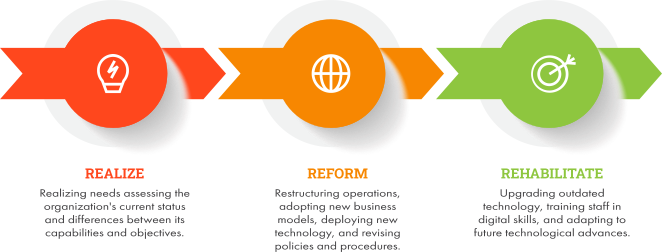
Three stages—realize, reform, and rehabilitate—are crucial for a successful digital transformation journey, enabling organizations to fully harness the power of digital innovations and remain relevant in a digital-first world.
- REALIZE: Engaging in digital transformation entails comprehending and recognizing the necessity for alteration. It entails acknowledging the potential and possibilities that digital technologies can offer to a company. This stage encompasses the identification of sectors that can derive advantages from digital innovation, the establishment of unambiguous goals, and the formulation of a vision for the digital future. Realization also entails evaluating the current condition of the company and comprehending the disparity between the existing capabilities and the intended digital objectives.

- REFORM: Reform in digital transformation involves making significant changes to an organization’s processes, structures, and strategies to seamlessly incorporate digital technologies. This phase involves the redesign of workflows, the adoption of new business models, the implementation of new technologies, and the updating of policies and procedures. Our goal is to optimize operations, elevate customer satisfaction, and foster expansion through the utilization of cutting-edge digital tools and methodologies. It frequently requires managing change to ensure that employees are in sync with the new methods of operation.
- REHABILITATE: Revitalizing and restoring the organization to a state of operational excellence using digital technologies is a crucial aspect of digital transformation. This requires a constant focus on enhancing and streamlining digital processes and systems. Rehabilitating may involve modernizing technology, providing digital skills training to employees, and ensuring the organization’s ability to adapt to future technological advancements. Our aim is to guarantee that the organization stays ahead of the game and adapts effectively to the ever-changing digital landscape.

Enterprise Architecture & ERP Implementation Governance
Transitioning complex organizational workflows into scalable ERP modernization architectures requires systematic alignment between core operational processes and underlying digital infrastructure across all operating subsidiaries. When executing enterprise deployments within intricate multi-entity business environments, organizations must rigorously prioritize data normalization, chart-of-accounts standardization, and unified telemetry architectures. Establishing resilient, pre-configured integration boundaries across legacy application estates directly eliminates technical debt while ensuring end-to-end data integrity across high-frequency transactional lifecycles. Cross-functional governance committees—uniting financial controllers, supply chain leaders, and enterprise technical architects—remain indispensable for maintaining strict configuration discipline and curbing procedural fragmentation across regional operating units.
Beyond core transactional execution, enduring platform longevity depends on deliberate organizational enablement and continuous operational validation across all stakeholder tiers. Implementing isolated sandbox environments, automated regression testing frameworks, and formalized release cadence protocols enables business units to absorb continuous platform enhancements without introducing unexpected downtime or operational friction. Enterprises that deliberately pair proactive telemetry monitoring with targeted role-based training programs consistently achieve accelerated user adoption, compress post-go-live stabilization horizons, and maximize the long-term return on strategic technology investments. This disciplined operating model provides the institutional agility needed to scale operations predictably.






No comment yet, add your voice below!