

It is everything what Dynamics 365 for Financials/for Finance and Operations, Business Edition was. That means a modern cloud based software-as-a-service solution, fully integrated to Office, PowerApps, Microsoft Flow and Power BI. But it is also a full Microsoft Dynamics NAV, where the previous version only had a subset of NAV.
Dynamics 365 Business Central will be generally available on April 2, 2018, in 14 countries – United States, Canada, United Kingdom, Denmark, Netherlands, Germany, Spain, Italy, France, Austria, Switzerland, Belgium, Sweden, and Finland, purchased through Microsoft Cloud Solution Provider (CSP) partners. Australia and New Zealand will be generally available beginning July 1, 2018.
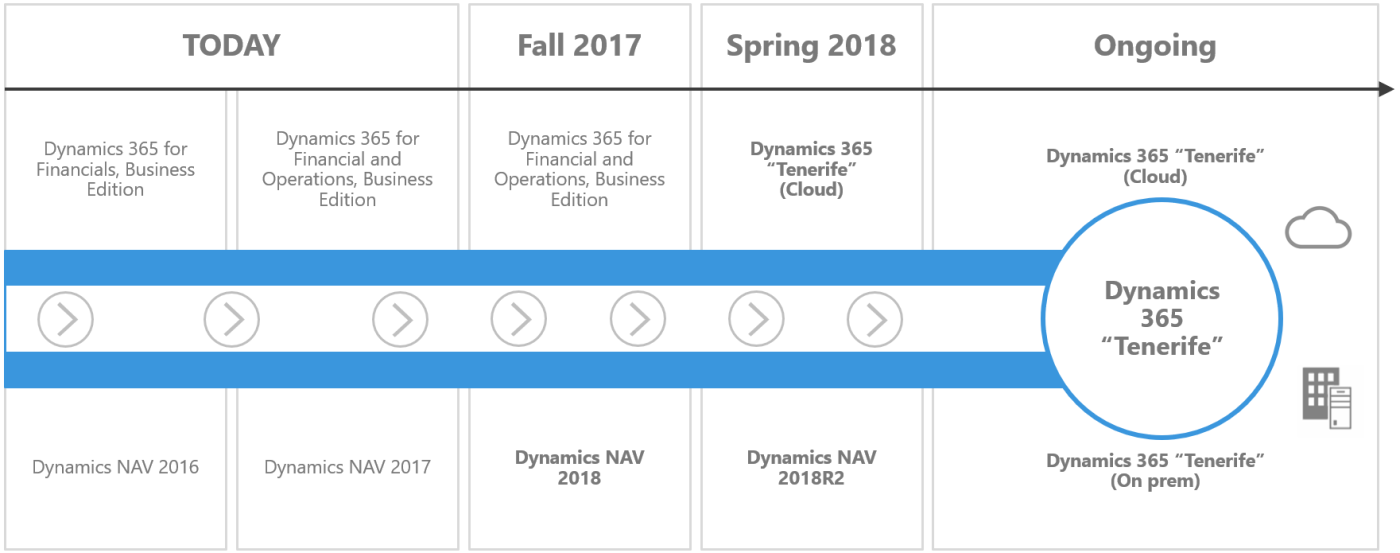

What does this mean to Dynamics NAV?
Please notice that the announcement does not apply to Microsoft Dynamics NAV. At least not now. The Spring 2018 release, will still be called Dynamics NAV. But according to Microsoft’s “roadmap to Tenerife” then after NAV 2018 R2, Business Central will be the name for both on-premise and cloud will the same. This may be in Q4, or it may be later. No announcement of this so far.
So right now, nothing is changed for customers with Microsoft Dynamics NAV. You may relax again!
Enterprise Architecture & ERP Implementation Governance
Transitioning complex organizational workflows into scalable ERP modernization architectures requires systematic alignment between core operational processes and underlying digital infrastructure across all operating subsidiaries. When executing enterprise deployments within intricate multi-entity business environments, organizations must rigorously prioritize data normalization, chart-of-accounts standardization, and unified telemetry architectures. Establishing resilient, pre-configured integration boundaries across legacy application estates directly eliminates technical debt while ensuring end-to-end data integrity across high-frequency transactional lifecycles. Cross-functional governance committees—uniting financial controllers, supply chain leaders, and enterprise technical architects—remain indispensable for maintaining strict configuration discipline and curbing procedural fragmentation across regional operating units.
Beyond core transactional execution, enduring platform longevity depends on deliberate organizational enablement and continuous operational validation across all stakeholder tiers. Implementing isolated sandbox environments, automated regression testing frameworks, and formalized release cadence protocols enables business units to absorb continuous platform enhancements without introducing unexpected downtime or operational friction. Enterprises that deliberately pair proactive telemetry monitoring with targeted role-based training programs consistently achieve accelerated user adoption, compress post-go-live stabilization horizons, and maximize the long-term return on strategic technology investments. This disciplined operating model provides the institutional agility needed to scale operations predictably.





No comment yet, add your voice below!