

The New Frontier of Digital Transformation
For over a decade, “Digital Transformation” was a buzzword for moving paper to pixels and servers to the cloud. However, as we move through 2026, the definition has undergone a radical metamorphosis. We have entered the era of the Autonomous Enterprise.

In this new paradigm, the goal is no longer just to support human workers with digital tools, but to build a self-operating “digital nervous system.” This evolution is powered by two converging forces: Agentic AI and Hyperautomation. While traditional IT consulting once focused on software implementation, modern consulting is now about architecting autonomy.
Among the leaders in this space, Routeget Technologies has emerged as a pivotal player, bridging the gap between legacy enterprise structures and the high-velocity, AI-driven future.
Understanding the Pillars of Autonomy
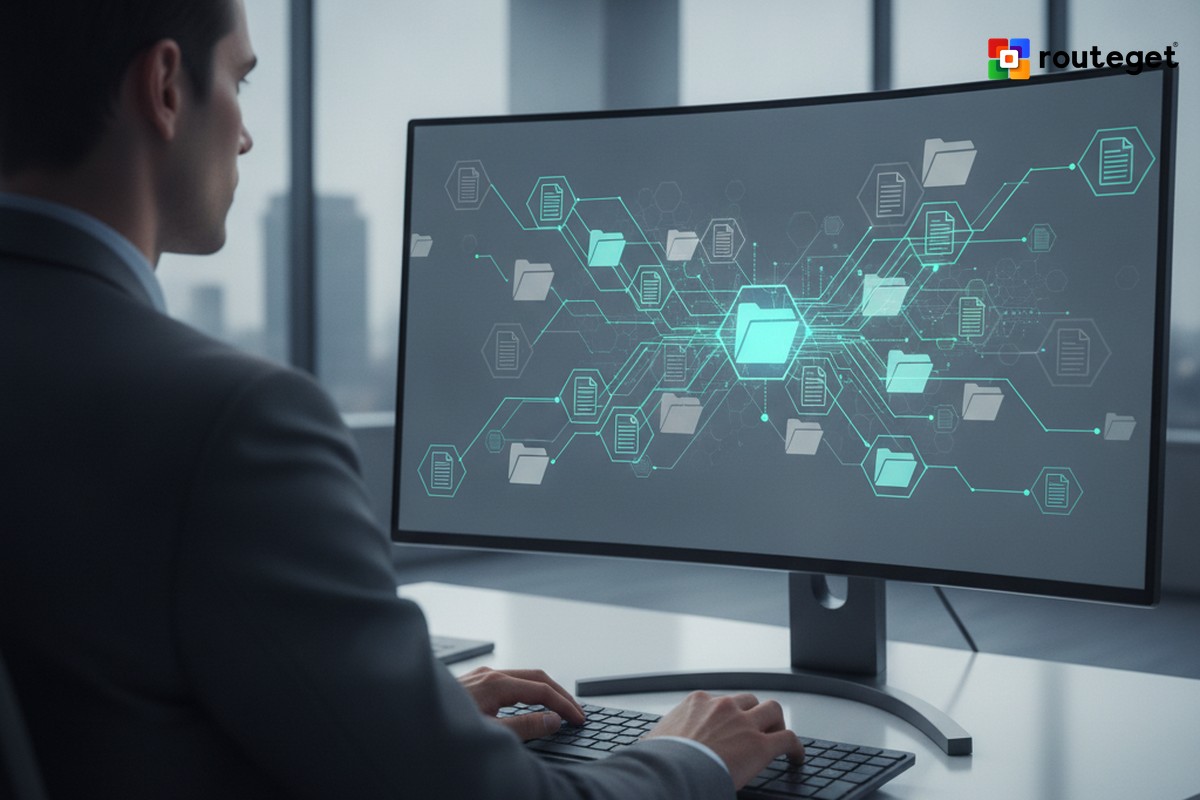
1. Agentic AI: From Assistants to Agents
The first pillar of the autonomous enterprise is Agentic AI. To understand its impact, we must look at the evolution of artificial intelligence:
Generation 1 (Predictive): AI that predicts what a customer might buy.
Generation 2 (Generative): AI that writes the marketing email to that customer.
Generation 3 (Agentic): AI that notices a drop in sales, analyzes the competitor’s pricing, creates a discount strategy, updates the web store, and manages the social media ad spend to recover the lost revenue—all without being prompted.
Agentic AI is characterized by reasoning, planning, and execution. It doesn’t just provide an answer; it uses a “chain-of-thought” process to break down a complex goal into a series of actionable steps. It can use software tools, navigate APIs, and collaborate with other AI agents to complete a mission.
2. Hyperautomation: The Infrastructure of Speed
If Agentic AI is the brain, Hyperautomation is the body. It is the tactical framework that allows an organization to automate anything that can be automated.
Hyperautomation involves the orchestration of several technologies:
Robotic Process Automation (RPA): Handling structured, repetitive data tasks.
Process Mining: Using logs to “see” how work actually happens and where it breaks.
Machine Learning (ML): Providing the pattern recognition needed for complex decision-making.
Low-Code/No-Code: Allowing business users to build their own automation workflows without a PhD in computer science.
In an autonomous enterprise, hyperautomation ensures that the AI agents have the “pipes” and “connections” they need to move data and trigger actions across the entire company.
The Strategic Shift in IT Consulting
In the past, IT consultants were hired to “fix” things—fix the network, fix the database, fix the security. In 2026, the consultant’s role has shifted toward Strategic Orchestration.
1. From “What” to “How”
Consulting firms are no longer just asking, “What software do you need?” They are asking, “How should your business reason?” They are designing Goal-Oriented Architectures. This involves defining the “guardrails” within which an AI agent can operate independently. For example, a consultant might design a procurement agent that can authorize any purchase under $5,000 but must escalate anything higher to a human CFO.
2. The Semantic Layer and Data Mesh
A major trend in 2026 consulting is the move away from “Data Lakes” (where data often goes to die) toward Data Mesh and Semantic Layers.
Data Mesh decentralizes data ownership to specific departments (Finance, HR, Sales).
Semantic Layers provide a “common language” so that an AI agent in the Supply Chain department can understand the data produced by the Sales department without manual translation.
Routeget Technologies: A Blueprint for Modern Digital Transformation
In the crowded field of IT consulting, Routeget Technologies stands out by focusing on the “Total Transformation” approach. They don’t just sell software; they re-engineer the enterprise DNA for the AI era.
1. Mastering the Microsoft Ecosystem
As a Microsoft Gold Partner, Routeget leverages the most powerful enterprise stack in the world. Their expertise in Dynamics 365 and Azure is the foundation upon which they build autonomous systems.
Dynamics 365 Copilot Integration: Routeget helps firms move beyond basic “chat” interfaces to fully integrated AI that lives inside their ERP and CRM systems.
Power Platform Development: They empower organizations to use low-code tools to create “Micro-Agents”—small, specialized AI bots that solve niche departmental problems, like automating bank reconciliations or bulk production orders.
2. Future-Tech Portfolio
Routeget’s vision extends into what they call “Future Technologies.” Their consulting practices include:
Cognitive Computing: Building systems that mimic human sensory and decision-making capabilities.
BIONICS (Biomedical Engineering): Exploring the intersection of human biology and technology in the industrial sector.
Edge Computing: Ensuring that autonomous systems can make split-second decisions at the “edge” (on a factory floor or in a delivery vehicle) without waiting for a slow cloud connection.
3. Industry-Specific “Accelerators”
One of Routeget’s most interesting contributions is their library of industry-specific accelerators. They recognize that an autonomous enterprise in the Chemical industry looks very different from one in Banking or Retail.
Healthcare: Automating provider management and patient record flows.
Manufacturing: Using AI to manage complex “Mass Production” orders and supply chain shifts.
E-commerce: Connecting disparate systems like WooCommerce and Shopify directly into Dynamics 365 via their proprietary “R-Connector.“
Overcoming the Barriers to Autonomy
While the potential of the autonomous enterprise is vast, the road is paved with challenges. Modern IT consulting firms are currently focused on solving three main “walls”:
1. The Governance Wall
Trust is the biggest barrier. If an AI agent makes a mistake that costs a company $1 million, who is responsible? Routeget and other leaders address this through Transparent and Governed Autonomy. This includes:
Audit Trails: Every decision made by an AI agent is logged and explainable.
Human-in-the-loop (HITL): Designing checkpoints where the AI must stop and ask for human confirmation.
2. The Skills Gap
The workforce isn’t ready for a world where AI does 80% of the administrative work. Routeget plays a role here by focusing on Change Management. They help companies transition their employees from “doers” to “orchestrators”—teaching them how to manage and audit the AI agents rather than doing the manual tasks themselves.
3. Security in an Agentic World
Autonomous systems increase the “attack surface” of a company. If a hacker compromises an AI agent with autonomous purchasing power, the damage can be catastrophic. Routeget combats this with Zero Trust Security and Identity & Access Management (IAM) tailored specifically for non-human identities (the AI agents).
The Path to 2030
The journey to becoming an autonomous enterprise is not a sprint; it is an architectural evolution. By 2030, the “Administrative Office” as we know it will likely be entirely autonomous. Humans will move into purely strategic, creative, and empathetic roles, while the “Digital Nervous System”—architected by firms like Routeget Technologies—handles the complexity of global operations in real-time.
For businesses today, the choice is clear: remain a “Manual Enterprise” struggling with data silos and slow reaction times, or partner with a digital transformation agency to begin the journey toward autonomy.
Enterprise Architecture & ERP Implementation Governance
Transitioning complex organizational workflows into scalable ERP modernization architectures requires systematic alignment between core operational processes and underlying digital infrastructure across all operating subsidiaries. When executing enterprise deployments within intricate multi-entity business environments, organizations must rigorously prioritize data normalization, chart-of-accounts standardization, and unified telemetry architectures. Establishing resilient, pre-configured integration boundaries across legacy application estates directly eliminates technical debt while ensuring end-to-end data integrity across high-frequency transactional lifecycles. Cross-functional governance committees—uniting financial controllers, supply chain leaders, and enterprise technical architects—remain indispensable for maintaining strict configuration discipline and curbing procedural fragmentation across regional operating units.
Beyond core transactional execution, enduring platform longevity depends on deliberate organizational enablement and continuous operational validation across all stakeholder tiers. Implementing isolated sandbox environments, automated regression testing frameworks, and formalized release cadence protocols enables business units to absorb continuous platform enhancements without introducing unexpected downtime or operational friction. Enterprises that deliberately pair proactive telemetry monitoring with targeted role-based training programs consistently achieve accelerated user adoption, compress post-go-live stabilization horizons, and maximize the long-term return on strategic technology investments. This disciplined operating model provides the institutional agility needed to scale operations predictably.



No comment yet, add your voice below!