

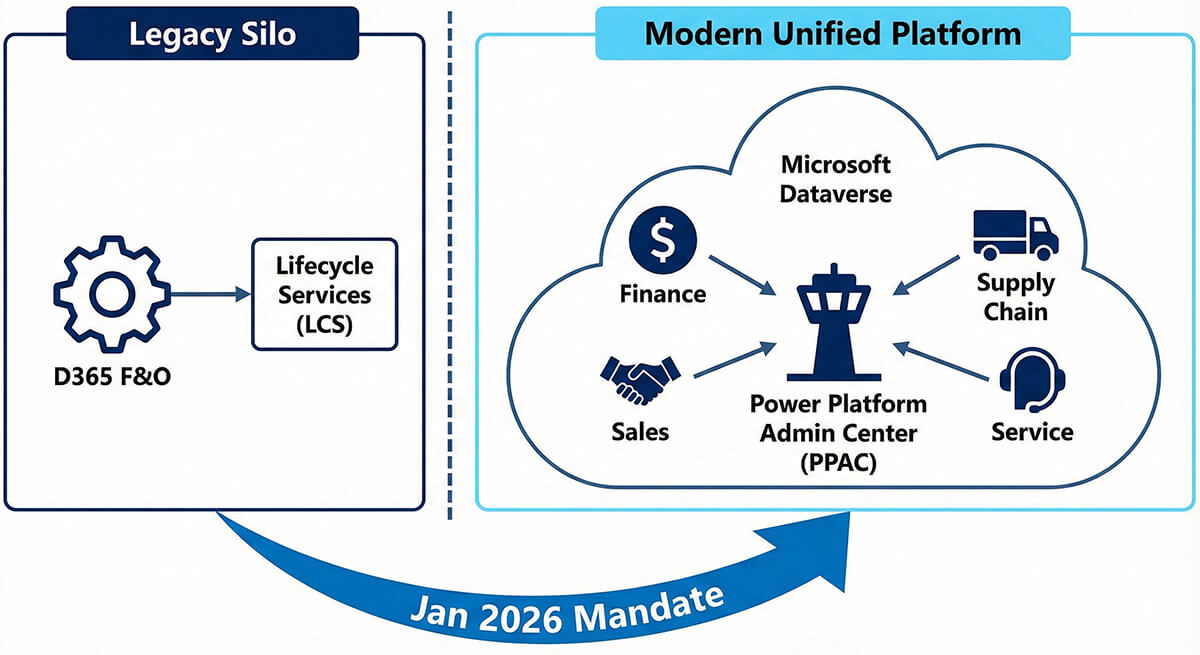
The era of siloed ERP management is officially ending. Microsoft has drawn a line in the sand: starting January 2026, Lifecycle Services (LCS) will close its doors to new Dynamics 365 Finance & Operations (F&O) projects. All future implementations must be provisioned, managed, and maintained exclusively through the Power Platform Admin Center (PPAC).
While existing implementations currently remain on LCS, this move sends an undeniable message to the entire ecosystem: PPAC is the only future destination for Dynamics 365
The “Why”: Understanding One Dynamics One Platform (ODOP)
To understand the death of LCS for new projects, one must understand Microsoft’s overarching strategy: One Dynamics One Platform (ODOP).
Historically, D365 F&O (formerly AX) and D365 Customer Engagement (CE/CRM) existed in parallel universes. F&O lived in LCS, ran on proprietary infrastructure, and used X++ code. CE lived on the Power Platform, ran on Dataverse, and used C#/.NET. Connecting them required complex middleware or “Dual-write” configurations.
The ODOP initiative aims to merge these technological stacks. Microsoft’s goal is for an F&O environment to be treated just like any other Power Platform environment (like Sales or Service).
LCS, built specifically for the unique architecture of old F&O, is incompatible with this unified future. It is a legacy portal sustaining a legacy architecture. The PPAC is the unified management hub designed for the converged stack, centered around Microsoft Dataverse.

The Paradigm Shift: LCS vs. PPAC
Moving from LCS to PPAC is not merely changing portals; it is fundamentally changing how an ERP system is perceived and managed within the IT landscape.
| Feature/Concept | The LCS Era (Legacy) | The PPAC Era (Future State) |
| Core Philosophy | F&O is a unique, standalone heavy ERP beast requiring specialized tooling. | F&O is a high-complexity workload running on top of the Power Platform/Dataverse. |
| Environment Provisioning | Done via LCS portal. F&O environments are distinct entities. | Done via PPAC. An F&O instance is tied 1:1 with a Dataverse environment. |
| Database Access | Just-in-Time (JIT) access to SQL Azure, heavily restricted. | Tighter integration with Dataverse; access managed via modern Azure security standards. |
| Extensibility | Primarily X++ development, managed via LCS Asset Library. | “F&O native” (X++) plus heavy emphasis on low-code (Power Apps), virtual tables, and Business Events via Dataverse. |
| ALM & Deployment | Manual package uploads to LCS Asset Library, deployed via LCS pipelines. | Modern CI/CD using Azure DevOps or GitHub, integrating with Power Platform pipelines for unified deployment across ERP and CRM. |
| Integration | Dual-write (often brittle) required for near-real-time sync with CE. | Virtual entities and native Dataverse integration become the standard, simplifying data sharing. |
Key Benefits of the Unified PPAC Model
While change is difficult, the shift to PPAC offers significant long-term advantages for customers and implementation partners:
1. Simplified Governance and Security
IT departments often struggle with managing F&O licenses in one portal and CE/Power Automate licenses in another. PPAC provides a “single pane of glass” for viewing capacity, storage, licenses, and security roles across the entire business application landscape.
2. Democratization of ERP Data
By linking F&O environments directly to Dataverse, the barrier to entry for using ERP data is lowered. Makers can build Power Apps or Power BI reports against F&O data using Virtual Tables without needing deep X++ knowledge or complex integration projects.
3. Modernized ALM (Application Lifecycle Management)
LCS deployments were often slow and manual. The move to PPAC facilitates “unified engineering.” It allows organizations to use standard, modern DevOps tools (Azure DevOps, GitHub Actions) to deploy changes to both F&O and Power Platform components simultaneously in a single pipeline.
The Critical Roadmap: Preparing for 2026
January 2026 is rapidly approaching in ERP implementation terms. A large-scale enterprise project starting in mid-2025 will likely go live after the deadline. Therefore, the time to adapt is now.
What happens to existing LCS customers?
For now, Microsoft has indicated that existing implementations managed in LCS will continue to function. However, history suggests this will not last forever. While they may not force migration immediately in 2026, new features, innovations, and perhaps even critical updates will increasingly be prioritized for PPAC-managed environments. Existing customers should begin planning a long-term migration strategy to PPAC.
Action Plan for Partners and Implementation Teams
Stop Selling LCS-First Architectures: Any proposal for a project likely to go live in late 2025 or beyond should assume PPAC as the management foundation. Selling an LCS implementation now is selling technical debt.
Retrain Infrastructure Teams: The role of the “F&O Basis/Infrastructure Consultant” is changing. They need to become Power Platform architects. Deep knowledge of Dataverse environments, solutions, and PPAC governance is now mandatory for ERP practitioners.
Re-engineer ALM Pipelines: Move away from the LCS Asset Library as the source of truth. Invest in building robust CI/CD pipelines in Azure DevOps that utilize the new Power Platform build tools and F&O deployment tasks.
Action Plan for Customers
Challenge Your Partner: If you are about to sign a contract for a new D365 F&O implementation, ask your partner: “Will this be deployed on LCS or PPAC?” If the answer is LCS, demand a justification for why they are deploying you on a platform that will be deprecated for new projects before you even go live.
Evaluate Your Talent Pool: Does your internal IT team have Power Platform skills? If they only know traditional ERP management, invest in upskilling them on Dataverse and PPAC administration.
Conclusion
The requirement to use PPAC for all new D365 Finance & Operations implementations starting January 2026 is the final nail in the coffin for the old era of “Dynamics AX in the cloud.”
Microsoft is forcing the ecosystem to modernize. By unifying F&O infrastructure with the Power Platform, they are creating a more powerful, extensible, and manageable suite of applications. While the transition requires significant re-tooling and re-learning for partners and customers alike, the destination—a unified, Dataverse-centric enterprise platform—is inevitable. Adapt now, or be left managing legacy infrastructure in a modern world.
Enterprise Architecture & ERP Implementation Governance
Transitioning complex organizational workflows into scalable ERP modernization architectures requires systematic alignment between core operational processes and underlying digital infrastructure across all operating subsidiaries. When executing enterprise deployments within intricate multi-entity business environments, organizations must rigorously prioritize data normalization, chart-of-accounts standardization, and unified telemetry architectures. Establishing resilient, pre-configured integration boundaries across legacy application estates directly eliminates technical debt while ensuring end-to-end data integrity across high-frequency transactional lifecycles. Cross-functional governance committees—uniting financial controllers, supply chain leaders, and enterprise technical architects—remain indispensable for maintaining strict configuration discipline and curbing procedural fragmentation across regional operating units.
Beyond core transactional execution, enduring platform longevity depends on deliberate organizational enablement and continuous operational validation across all stakeholder tiers. Implementing isolated sandbox environments, automated regression testing frameworks, and formalized release cadence protocols enables business units to absorb continuous platform enhancements without introducing unexpected downtime or operational friction. Enterprises that deliberately pair proactive telemetry monitoring with targeted role-based training programs consistently achieve accelerated user adoption, compress post-go-live stabilization horizons, and maximize the long-term return on strategic technology investments. This disciplined operating model provides the institutional agility needed to scale operations predictably.





No comment yet, add your voice below!